
Find People in Montgomery County
The best first record depends on what is known. A full name may lead to the county court index, an assessor owner search, a professional license, or a business filing. An old street address can be tied to a parcel and then to present and prior owners. A family name and date may point instead to a marriage file, probate claim, obituary, cemetery source, or an older county volume. Clarksville is the county seat and the county's only incorporated city, so city and county sources often overlap without being the same system.
Use official indexes to separate people who share a name. Middle initials, suffixes, spouse names, record dates, and the role a person plays in a document all matter. A grantor transfers an interest in land; a grantee receives it. A court party may be a plaintiff, defendant, appellant, or another participant. An address can be a tax mailing address instead of a home. No single match proves identity.
- Search the assessor by owner name or property address and note the parcel identifier.
- Use the parcel's deed reference to move into the Register of Deeds index.
- Check local court systems by party name, court type, case year, and case number when known.
- Use vital and historical records for family links, dates, and prior generations.
- Ask the correct custodian for a counter search or copy when the online trail stops.
Montgomery County People Records Offices
Montgomery County divides name-rich files among elected offices and clerks. The Register of Deeds records deeds, liens, plats, powers of attorney, releases, and other land instruments. The Assessor links owners to parcels, values, sales, and improvements. The County Clerk handles marriage licenses and other statutory services. Circuit, General Sessions, Chancery, probate, juvenile, and municipal matters do not all sit with one clerk.
These offices are also the fallback when a portal has a cutoff, paid access, or no usable online index. The complete rules for inspection, copies, and requests are covered in the Montgomery County public records system. Start with the custodian that created or keeps the record, then give a name, date span, address, parcel, case, or instrument number.
Register of Deeds
350 Pageant Lane, Suite 101-A
Clarksville, TN 37040
931-648-5713
Property Assessor
350 Pageant Lane, Suite 101-C
Clarksville, TN 37040
931-648-5709
Note: Probate and Chancery files route to the Clerk and Master, not the Montgomery County Clerk.
Search Montgomery County Property Owners
The free Montgomery County Citizen Access Portal is a strong starting point for either a person or a place. It connects assessor records with current ownership, assessment, transfer, sales, and property details. When a street address has changed or a lot has been split, the parcel identifier is a more stable bridge than the mailing label alone. The county GIS adds boundaries, rights-of-way, subdivision lines, aerial images, and adjoining parcels.
The assessor maintains about 904 maps. Rural tracts use a different scale from urban parcels, and the office began moving hand-drafted maps into GIS in 1998. That history matters when a present web map does not explain an older legal description. Paper-map consultation may still solve a mismatch. A postal address that says Clarksville may also fall outside city limits, so the GIS boundary helps identify whether a city or county permit office should hold the next record.
The official property search screen shows the local interface used to begin that work.
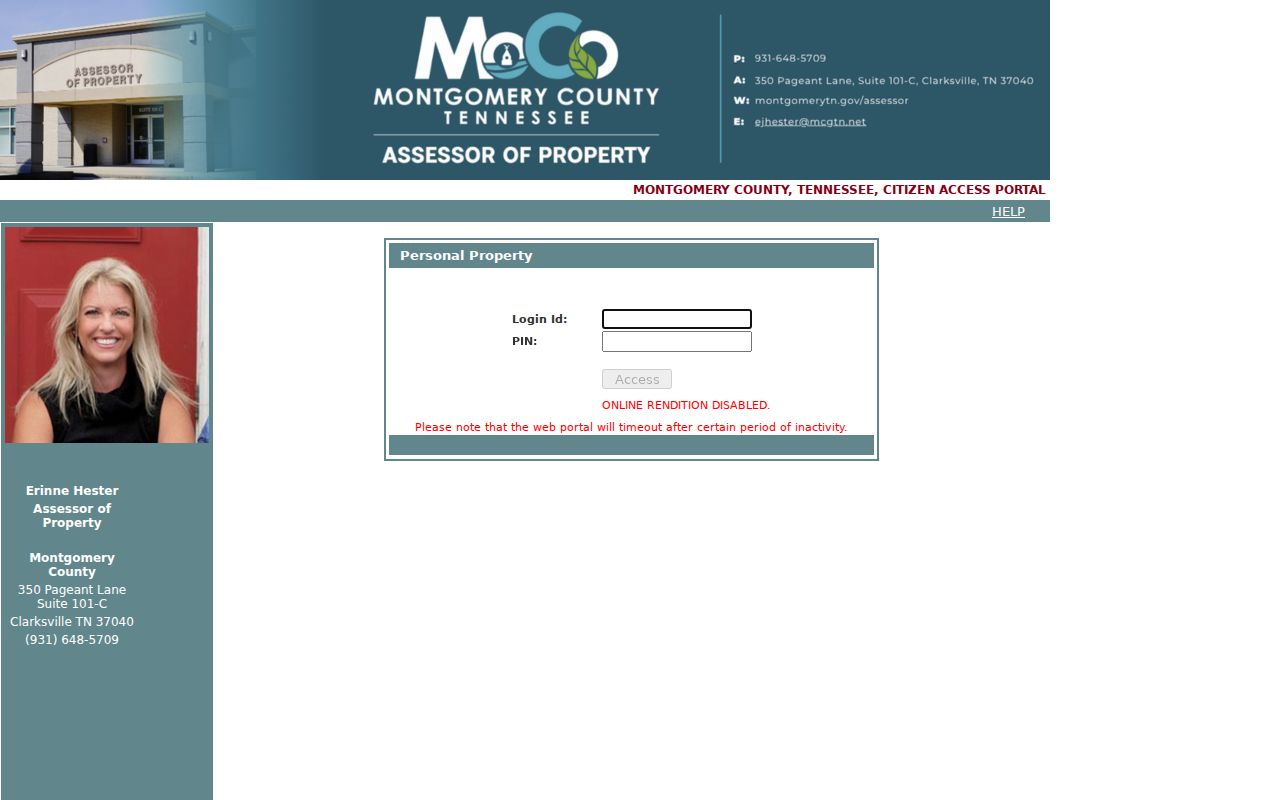
Use its result as an index, then confirm the owner, mailing address, parcel, and deed reference against the underlying county records.
Trace Montgomery County Deed Records
A parcel record can lead to the recorded instrument that explains ownership. Montgomery County's Register of Deeds indexes warranty and quitclaim deeds, deeds of trust, releases, assignments, liens, plats, agreements, substitute trustees, powers of attorney, and probated wills tied to county real estate. Warranty-deed index data may include new-owner and tax-bill names, addresses, map and parcel references, consideration, legal description, derivation, grantor, and grantee.
Most remote Register records use the paid US Title Search service, which the county says updates every 15 minutes and has offsite backup. That is not the only route. Free office computers are available. A requester may also ask by email, phone, or mail, with a self-addressed stamped envelope, payment, and volume and page when known. Older books and indexes remain with the Register and County Archives. The office will provide records, but it does not perform a title search or decide the legal effect of a lien.
- Index
- A finding aid that points to a filed document; it is not always the full image.
- Grantor
- The person or entity transferring the recorded interest.
- Grantee
- The person or entity receiving the recorded interest.
- Plat
- A recorded map showing lots, boundaries, and subdivision details.
Note: Military discharge records have special limits and should not be treated like an open deed or plat.
Search Montgomery County Court Records
Montgomery County belongs to Tennessee's 19th Judicial District. Circuit and General Sessions files are kept at 2 Millennium Plaza, while Chancery and probate matters go to the Clerk and Master. Clarksville Municipal Court covers traffic, building, code, and other city ordinance cases. Tennessee does not provide one complete statewide trial-court name index, so the court level must be identified before a search begins.
The county's Online Court Records search covers criminal and traffic cases from November 1, 1999 to the present and civil cases from May 1, 2006 to the present. The county publishes shared credentials on its instruction page. Search fields include party name or case reference, case year, case number, court type, and civil or criminal case type. Begin with a broad party name, then add a year or court filter if the result set is large.
| Record system | Scope | Useful search key | Fallback |
|---|---|---|---|
| County Online Court Records | Circuit and General Sessions | Party, year, case number | Circuit Court Clerk |
| Clerk and Master | Chancery and probate | Decedent, estate, case | Counter or copy request |
| Municipal Court search | Clarksville ordinance cases | Case search | Municipal Court Clerk |
| Public Case History | Tennessee appellate cases | Party, style, number, entity | Originating clerk |
The statewide Public Case History tool covers appellate filings after September 1, 2006, not every local trial case. Federal cases use PACER and the Middle District of Tennessee. Sealed and expunged cases, adoption files, and protected juvenile matters do not become searchable merely because other dockets are open.
Montgomery County Cross-Border Searches
Fort Campbell sits across the Tennessee and Kentucky line. One household can leave a Clarksville mailing record, a Christian County record, and a federal military trail. Search both counties when a Fort Campbell link is known. Military personnel files are federal records and do not belong to Montgomery County, while deeds, taxes, local court cases, and county vital events stay with the office that has jurisdiction.
Local geography creates a second boundary issue. Clarksville is the county's service center, but it is not a consolidated city-county government. Sango, Woodlawn, Cunningham, Palmyra, Southside, Dotsonville, and St. Bethlehem may appear in an address, a community label, or an older record. Countywide records should still be checked. ZIP codes do not set municipal jurisdiction.
This cross-border check is especially useful when a current directory ends abruptly. APSU records can show a former campus role, public unit histories can add military context, and county deeds may document a home interest. Each record should be read for the role it actually proves.
Access Montgomery County Vital Records
Tennessee Vital Records keeps original birth, death, marriage, and divorce records. The Montgomery County Health Department may issue any registered Tennessee birth or death certificate electronically. Marriage licenses begin with the County Clerk. A divorce decree remains with the court that entered it, while the state issues a vital-event certificate. Those products answer different questions.
Recent certificates are not ordinary open records. Tennessee law and vital-record rules limit certified copies to the registrant and certain relatives, guardians, representatives, or people who show a qualifying need tied to personal or property rights. Cause-of-death access is narrower. State-held births open after 100 years; deaths, marriages, divorces, and annulments open after 50 years. Older qualifying records may then be researched through the Tennessee State Library and Archives or local microfilm.
The Tennessee vital-record application hub lays out forms, identity proof, ordering channels, and fees.
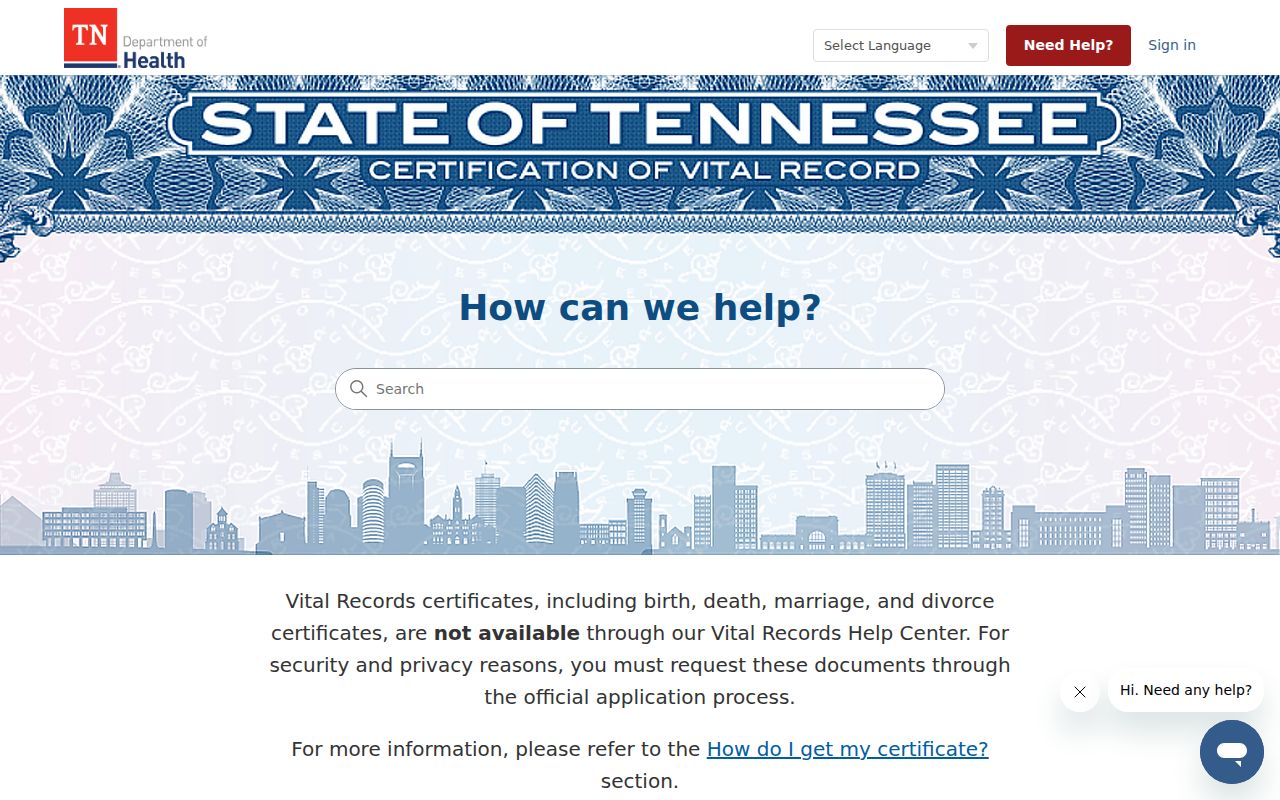
The application route matters because a certificate search, a certified copy, and the originating court or clerk file are not interchangeable.
Note: State certificates cost $15, while an authorized online vendor may add its own service charge.
Check Montgomery County Voter Records
Tennessee's official voter lookup is a self-verification tool, not an open browse of every local voter. It requires Montgomery County, first name, last name, birth month, and birth year. A match can provide the current registered address, polling place, and representatives. If the entries do not match, the tool tells the voter to check the information and contact the county office.
The Montgomery County Election Commission is at 350 Pageant Lane, Suite 404, and can verify the record through the proper channel. The lookup showed a specific data-current date during research, so a no-match should never be treated as final proof. Tennessee does not register voters by party, and participation history does not reveal ballot choices. Social Security numbers and online or driver identifiers are protected.
Bulk voter data has a different rule. County files can include selected districts, wards, registration details, phone and address fields, and participation history, but the requester must certify political-purpose use under Tennessee law and pay the listed product fee. The full process and confidentiality split are detailed with the Montgomery County voter registration lookup.
Search Montgomery County Custody Records
Custody records are split by agency. The Montgomery County Sheriff's Office maintains the local booking inquiry. Tennessee's Felony Offender Information Lookup covers current and former state felony custody or supervision. The federal Bureau of Prisons has its own locator. A person may appear in one system and not another because each database serves a different custody level.
The Montgomery County booking inquiry is the official local web starting point.
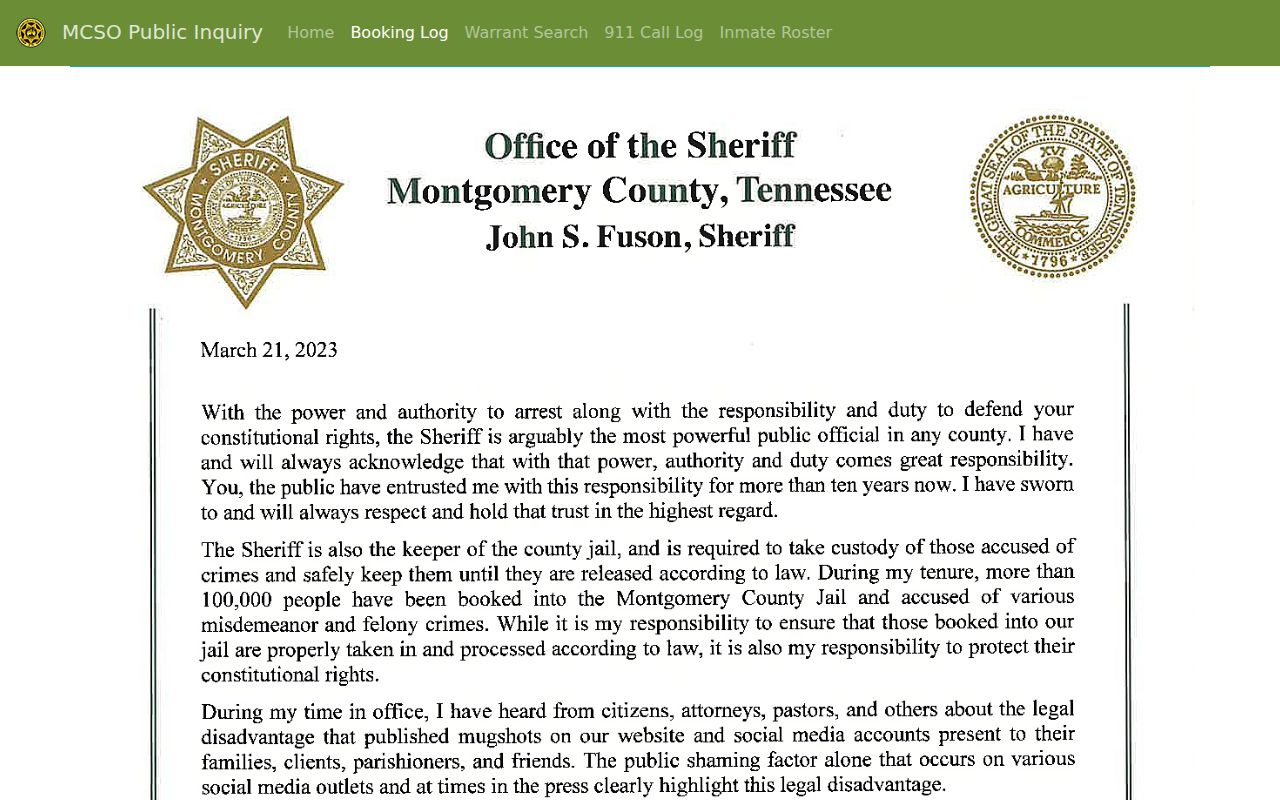
A booking result should be checked against the Sheriff's Office because custody and case status can change, and a jail listing is not the same as a conviction record.
The Sheriff also separates incident, accident, general public-record, and interagency report requests. Some reports may be withheld or redacted. For a statewide offender search, Tennessee FOIL accepts a name, TDOC ID, or state ID and may return status, location, offense, sentence, parole hearing, and release information. The TBI registry is another distinct source and forbids threats, stalking, intimidation, or harassment.
If a public listing exposes data used in a fraud, preserve the source and use the Tennessee Attorney General's identity-theft resources for recovery steps.
Explore Montgomery County Genealogy Records
Modern portals do not hold the whole name trail. The Brown Harvey Sr. Genealogy Room at the Clarksville-Montgomery County Public Library has books, microfilm, historic newspapers, death certificates, and on-site databases. Its exact city, telephone, and reverse-directory years are not posted, so staff or the catalog should be asked for a title and year. That small step can turn an old address into an occupant name.
The Montgomery County Archives, created by the County Commission in 1995, is the official repository for permanent county records. Its Library Genealogical Materials Collection spans 1803 through 2016 and includes family Bibles, family trees, letters, military papers, photos, community materials, and early church records. The Archives can act as a second index when a courthouse abstract omits associates or a web portal begins too late.
Printed sources add detail. The Montgomery County Historical Society identifies ten volumes of early Court of Pleas and Quarter Sessions minutes, eleven volumes of Clarksville newspaper obituaries from 1810 through 1940, and an 1859-1860 Clarksville city directory. APSU Archives contributes yearbooks, student newspapers, catalogs, photographs, and manuscripts.
Trace Montgomery County Heir Records
Probate, obituaries, and deeds can form an official trail for an heir or unknown branch of a family. Start with the decedent's name in Chancery and probate records. An estate-claim form can identify the estate, case number, creditor, address, dates, and amounts. A recorded will may also appear in the deed system when the decedent owned real estate in Montgomery County.
Next, compare the probate names with newspaper obituaries and deed transfers. An obituary can name relatives and service places, but it is a publisher-held notice rather than a certified death record. A deed shows parties and a land transaction, not every family relationship. The County Archives may preserve loose packets, court minutes, tax records, and older volumes that name witnesses or associates missing from a brief online index.
Common names require care. Search surname variants, middle initials, suffixes, spouse names, and both grantor and grantee roles. Dates and addresses should agree across more than one independent record before two entries are treated as the same person. The Tennessee unclaimed-property search offers another free name check for owners and heirs, with no state claim fee or claim deadline.
Request Montgomery County Records Offline
An online cutoff is not proof that an older file was lost. Montgomery County digitized each record series on its own schedule. The Register keeps books and offers office, mail, email, and phone routes. Court clerks hold the originating trial files. The County Archives keeps permanent historic material. The library adds microfilm and local publications. Choose the fallback based on who created the record.
For city material, the Clarksville City Clerk routes general requests through the GovQA Public Records Center. Give the department, date span, person or address, and whether inspection or an electronic copy is wanted. Under the Tennessee Public Records Act, the statutory right belongs to Tennessee citizens. Inspection is free unless another law applies. If records cannot be produced promptly, the custodian generally has seven business days to produce them, deny the request with a legal basis, or give a written estimate of when they will be ready.
Keep the request narrow. Agencies do not have to answer a question or create a new explanation. Ask for an existing record type and add the date, name, address, case number, parcel, or instrument reference that will help staff locate it. The Office of Open Records Counsel provides guidance and mediation when access is disputed.
Note: A failed web search is a reason to change channels, not proof that no Montgomery County record exists.