
Montgomery County Open Records at a Glance
Montgomery County divides records by the act that created them. The Register of Deeds keeps recorded land instruments. The Assessor maintains parcel and value data. Trial-court files stay with the clerk for the court where a case began. Recent vital certificates follow Tennessee entitlement rules rather than the ordinary open-record process. This coverage table leads to the correct custodian and shows when online access is only one part of the route.
| Montgomery record | Office that keeps it | Web route | Other access |
|---|---|---|---|
| Deeds, liens, plats | Register of Deeds | Paid remote title index | Free office computers; mail, email, or phone copies |
| Property and GIS | Assessor of Property | Citizen Access Portal and GIS | Office counter and paper maps |
| Trial and probate cases | Circuit Court Clerk or Clerk & Master | Local Circuit and General Sessions search | Clerk counter and copy request |
| Birth, death, marriage, divorce | Health Department, County Clerk, court, or state | Applications, not an open name index | Entitlement-based in-person or mail order |
| Jail and offender information | Sheriff, TDOC, or TBI | Separate county and state lookups | Agency records request where permitted |
| Voter registration | Election Commission or Tennessee SOS | Private self-lookup | Purpose-limited paid voter file |
| Business and licenses | Secretary of State or regulatory board | Entity and credential searches | Agency document order or records request |
Open does not mean unrestricted. Tennessee law closes or limits adoption files, many juvenile matters, sealed or expunged cases, driver data, protected voter identifiers, military discharge papers, and recent vital records. A custodian may redact an exempt fact and release the rest. A missing web result also proves little because older material, restricted files, and some complete case records remain at the office or archives.
Montgomery County Deed Records Access
The Montgomery County Register of Deeds records as many as 98 instrument types. They include warranty and quitclaim deeds, deeds of trust, releases, assignments, liens, plats, powers of attorney, substitute-trustee papers, agreements, and some probated wills tied to county land. Warranty-deed index data may include grantor and grantee names, the new owner's tax-bill name and address, map and parcel identifiers, consideration, legal description, and the prior deed reference.
Remote access runs through a paid title-search service that the county says updates every 15 minutes and has offsite backup. The public office page does not state its first online year or subscription price, so no digital cutoff should be assumed. Free office computers provide another route. Searchers can also request a known volume and page by mail with a self-addressed stamped envelope and payment, or contact the office by email or phone. The Register supplies records but does not conduct a title search or decide whether a lien has legal effect.
| Indexed deed detail | What it identifies | How it helps |
|---|---|---|
| Grantor and grantee | Transferor and recipient | Follow ownership in both directions |
| Map and parcel | Assessor reference | Match the deed to the tax parcel |
| Legal description | Lot, tract, or boundary text | Separate similar addresses |
| Derivation | Earlier source deed | Continue the recorded chain |
Note: A mailing address receives tax notices; it does not by itself prove that the named owner lives on the parcel.
Montgomery County Property Records and GIS
The free Montgomery County Citizen Access Portal supports an owner-name search and exposes current assessment, transfer, and CAMA data. CAMA means computer-assisted mass appraisal, the system used to organize parcel values and characteristics. The linked county GIS viewer adds mapped parcel boundaries, rights-of-way, subdivisions, roads, aerial images, and parcel identifiers. Those sources answer different questions, so the map and property card should be read together.
The Assessor of Property maintains about 904 maps, with rural tracts drawn at one inch to 400 feet and urban land at one inch to 100 feet. Conversion from hand-drafted maps to GIS began in 1998. Older parcel research can still require a paper-map check at the office, especially after a split or combination. A prior parcel, parent tract, deed reference, or plat may bridge a gap that a current street address cannot.
A postal address that says Clarksville may sit beyond city limits. Check the GIS boundary before sending a permit or code request, because City of Clarksville departments and Montgomery County offices are separate custodians. County street-centerline metadata also says names are reviewed and updated weekly. That makes the standardized current street useful, but older deeds and directories may still use an earlier form.
Montgomery County Court Records Split
There is no single Tennessee trial-court name index. Montgomery County Circuit and General Sessions records belong to the Circuit Court Clerk, while Chancery and probate go to the Clerk & Master. Juvenile and Clarksville Municipal Court each have their own access rules and custodians. The county's Circuit Court Clerk portal covers criminal and traffic cases from November 1, 1999 to the present, and civil cases from May 1, 2006 to the present. The county publishes shared credentials for full access.
The local portal accepts a party name or case reference, but not both in the same field. Start with the party name, then narrow by year. At least one court type and one case type must be selected. Search terms combine, matching all terms is on by default, and the system considers the first ten words.
| Local court field | Input | Use |
|---|---|---|
| Party Name / Case Reference | Text, up to 100 characters | Enter one route, not both |
| Case Year | Four digits | Narrow by filing year |
| Case Number | Numeric portion | Target a known case |
| Court Type | Circuit or General Sessions | Select at least one |
| Case Type | Criminal or civil | Limit the case group |
The Tennessee Public Case History site is an appellate tool, not a complete statewide trial index. It covers appellate filings after September 1, 2006, with many linked documents from August 26, 2013 forward. A no-match there says nothing conclusive about a Montgomery County trial file.
Montgomery County Vital Record Limits
Vital certificates do not follow the ordinary TPRA inspection route. The Montgomery County Health Department can issue registered Tennessee birth and death certificates. Marriage licenses originate with the County Clerk, while divorce decrees remain with the originating court. The Tennessee Office of Vital Records maintains birth, death, marriage, and divorce records and issues vital-event certificates.
T.C.A. §§ 68-3-205 and 68-3-206, plus state rules 1200-07-01-.11 and .12, control disclosure. Certified copies generally require a qualifying relationship or a shown need to protect personal or property rights. Cause-of-death access is narrower. State-held births become public after 100 years; deaths, marriages, divorces, and annulments become public after 50 years. Older qualifying microfilm then shifts genealogy work toward the Tennessee State Library and Archives and local collections.
Each state certificate or added copy costs $15. Mail orders need a signed form, identification copy or notarization, and check or money order. In-person and authorized online ordering are also available, though online vendor charges can be added. For a divorce allegation or order, ask the court for the case file. For proof that the event occurred, request the state certificate.
What Montgomery County Records Withhold
The TPRA opens many government files, but it does not erase other confidentiality laws. Adoption files are sealed under T.C.A. § 36-1-126. Juvenile access depends on Juvenile Rule 114, and a qualifying expungement under T.C.A. § 40-32-101 is removed from public view. Driver information is governed by the federal Driver's Privacy Protection Act. Social Security numbers and certain online-registration identifiers in voter data are also confidential.
T.C.A. § 10-7-504 protects listed personal data, including many government workers' personal phone, banking, health, and retirement details. A mixed record should not always be withheld in full. When practical, the custodian redacts the exempt portion and releases the rest. Military discharge records receive special protection, even though most recorded land instruments are open.
The Tennessee Safe at Home program gives eligible survivors a substitute address and mail forwarding. Its protected address and participant file are confidential. The program does not remove older deeds or court files, but it changes how agencies handle current address data. Ask the keeper about a specific statutory boundary instead of assuming every name or address is open.
Montgomery County Open Records Desks
Most county record custodians work from the Pageant Lane complex or the downtown courts area. Counter service matters when a paid portal lacks the needed date, a full file is not published, or a certified copy must bear the keeper's seal. Call before a time-sensitive visit to confirm the current schedule and the exact office that holds the file.
Register of Deeds
350 Pageant Lane, Suite 101-A
Clarksville, TN
931-648-5713
Weekdays, 7:30 a.m. to 4:30 p.m.
Assessor of Property
350 Pageant Lane, Suite 101-C
Clarksville, TN
931-648-5709
Weekdays, 8 a.m. to 4:30 p.m.
Circuit Court Clerk
2 Millennium Plaza
Clarksville, TN
931-648-5700
Circuit and General Sessions files
Clerk & Master
2 Millennium Plaza, Suite 101
Clarksville, TN
931-648-5703
Chancery, probate, and tax-sale files
The County Clerk handles marriage licenses and several statutory clerk services, but probate belongs to the Clerk & Master. Police and jail requests go to the Sheriff's Office at 120 Commerce Street or the relevant city department. The Montgomery County Archives is the fallback for permanent historic county records transferred from active offices.
Montgomery County Safety and License Lookups
Booking, felony supervision, offender registration, and professional credentials come from different systems. The Montgomery County booking inquiry concerns the county jail. The Sheriff's Office routes incident, accident, general public-record, and interagency requests separately, and an exemption may limit a report. Tennessee FOIL covers current and former felony custody or supervision. The TBI registry is a separate public-safety database. None replaces the originating court file.
The official TBI offender registry search is one statewide access route for Montgomery County. Its map and search are meant for safety awareness, and the agency warns against threats, intimidation, stalking, or harassment.
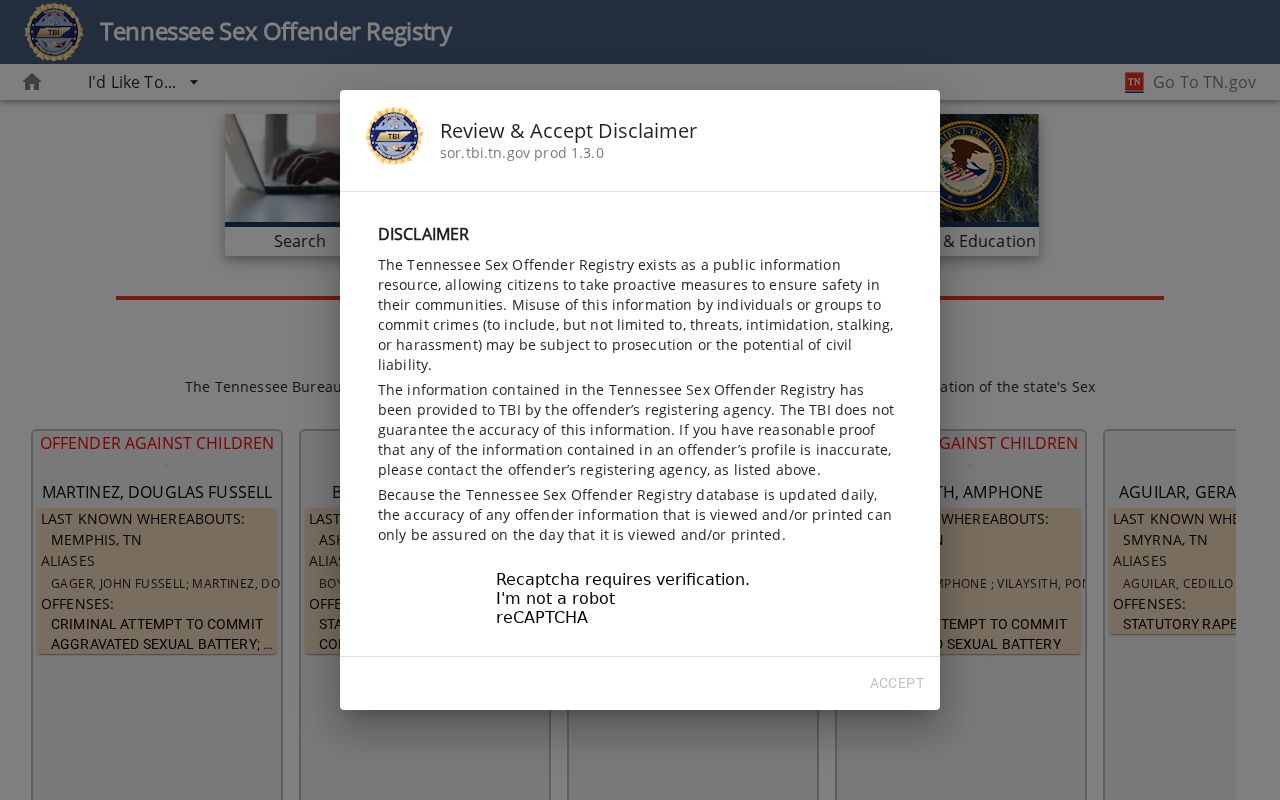
The screen illustrates why the registry should be searched as its own statewide source, then verified against the listed jurisdiction rather than merged with a county booking result.
Professional status belongs to the board that issued the credential. The Tennessee VerifyTN license search allows searches by profession or board, license type or number, name, place, and status.
License results can show credential type, number, standing, issue and expiration dates, and public discipline links. Confirm the responsible board because similar credential names can have different scopes.
Montgomery County Records Beyond the Web
An online index is a finding aid, not always the record itself. Montgomery County deed images may require paid remote access, while office computers are free. Known deed copies can be ordered by mail, email, or phone. Complete court files may require the clerk's counter. Historic volumes and microfilm can move from the active office to the Montgomery County Archives. Vital certificates use state or county application channels rather than a public name browse.
- Index
- A list of names and filing details that points to a source record.
- Image
- A scan of the filed paper, which may contain more facts than the index.
- Certified copy
- An official reproduction authenticated by the custodian.
- Custodian
- The office legally responsible for maintaining and releasing a record.
- Exemption
- A law that permits or requires all or part of a record to be withheld.
Start with the portal when it fits the date and record type. If it fails, note the name variants, date range, parcel or case number, and record series already checked. Take that compact description to the office. For older county material, ask whether the original, an index, or microfilm has been transferred before concluding the record is gone.
Note: Montgomery County Archives is a government repository for permanent records, not merely a private historical collection.
Montgomery County Deed Copy Warning
In May 2024, Register of Deeds Julie Chadwick Runyon warned residents about official-looking letters from a so-called Clerk's Property Office. The mail offered costly copies of recently recorded documents. Montgomery County stressed that copies were available directly from the real custodian at much lower statutory cost. A premium solicitation does not become an official notice merely because it quotes a true property filing.
Check the sender's domain and return address. Then contact the Register through the county's published number and ask for the plain-copy or certification cost. The Register records an instrument that meets state filing requirements but does not rule on whether the underlying deal is fraudulent. A person who suspects fraud may need both the filed document and help from the proper law-enforcement or legal channel.
Verify the seller of a record. Obtain deed copies through the Montgomery County custodian instead of paying an unsolicited company that mimics an official office.
Commercial Privacy Versus County Records
The Tennessee Information Protection Act, T.C.A. §§ 47-18-3201 and following, took effect July 1, 2025. It gives qualifying consumers rights against covered commercial controllers, including access, correction, deletion, portability, and opt-outs for certain data uses. It has scope thresholds and exclusions, and enforcement belongs to the Tennessee Attorney General.
Those commercial privacy rights do not erase a deed, tax roll, or court file that government must retain. Removing a profile from a commercial compilation also does not change the source held by Montgomery County. For an exposed detail in a government file, ask the actual custodian whether a specific redaction law applies. For instance, the Assessor's unlisted-owner web form can suppress an owner on that website, but the county warns that the underlying record remains subject to TPRA and may appear in other applications.
This split avoids a common mistake. Web suppression changes one display. Statutory confidentiality changes what government may release. A record correction addresses an error. Each remedy reaches a different system, so the request should identify both the data and the keeper responsible for it.
Requesting Montgomery County Public Records
The TPRA, T.C.A. §§ 10-7-501 through 10-7-515, grants inspection rights to Tennessee citizens, subject to statutory exceptions. A custodian may ask for proof of citizenship. Inspection is free unless another law applies. Copy requests may be put in writing, though an inspection-only request cannot be forced into written form. Agencies must provide existing records, but they do not have to answer questions or create a new report.
When a record cannot be produced promptly, the custodian generally has seven business days to produce it, deny access in writing with the legal basis, or provide a written estimate of when it will be ready. The Tennessee Office of Open Records Counsel publishes forms and offers guidance and mediation. Judicial enforcement is available in circuit or chancery court.
- Name the exact Montgomery County office that created or received the record.
- Check its index first, then note the person, address, date span, case, parcel, or instrument number that narrows the search.
- State whether inspection or copies are wanted and choose on-site, mail, or electronic delivery when offered.
- Ask for a cost estimate. The state schedule lists letter-size black-and-white copies at $0.15 and color copies at $0.50, plus qualifying actual labor.
- If access is denied, request the written legal basis. A narrower request, Open Records Counsel mediation, or court review may resolve the dispute.
The City of Clarksville has its own request channel for city-created records. County constitutional offices answer for their own files. Sending one broad demand to the wrong government can add delay, so identify whether the event belongs to Clarksville, a countywide office, a court, or a Tennessee agency before filing.
Lawful personal use. Open access never permits stalking, harassment, threats, intimidation, or unwanted surveillance. Tennessee criminal law and each portal's use terms still apply.